




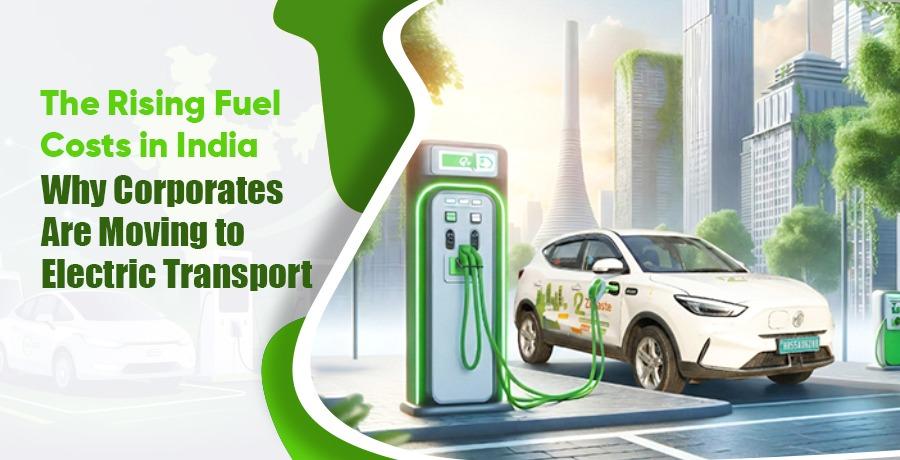
It is a radical change in the Indian corporate landscape. For decades, the steady drone of diesel engines and the scent of petrol fumes formed the default backdrop for employee commutes and logistics. But a look at the current fuel price boards at various city outlets in Gurugram and Noida shows why that age is fast approaching its end. Fuel costs have hit new highs and Indian businesses are no more just “considering” sustainability—they are running towards it.
The transition to Electric Vehicles for corporate use is no longer a luxury or a PR stunt; it is a strategic financial imperative. From startups in Gurgaon to established giants in Noida, the move toward electric cabs for corporate in Gurgaon transport is reshaping the bottom line and the environment.
The Economic Catalyst: The Fuel Price Crisis
Undoubtedly, the main motivation behind this change is economic. In India, rates of fuel are determined by global crude volatility, currency rate fluctuation and domestic taxation. For a company operating a large fleet of employee transport vehicles, 10 per cent increase in fuel rates translates into millions of rupees worth expenditure annually unplanned.
Conventional Internal Combustion Engine (ICE) vehicles are costlier to maintain. The "Cost per Kilometer" is nearing disastrous levels due to the new-cost (per liter of fuel) and maintenance programs for dated engines. Conversely, EVs have a much lower running cost. For the average electric car (EV), powering it would cost about 15-20% of a petrol or diesel equivalent. For a corporate organization operating hundreds of trips per day, those savings are huge.
Why Gurgaon and Noida are Leading the Charge
Hubs such as Gurgaon and Noida in the NCR are at the forefront of this EV revolution. There are a few reasons these cities could serve as the ideal testing ground for the best electric car for corporate in noida:
- Development of Infrastructure: These cities have been bolstered with a rapid deployment of charging stations from its public as well as corporate parks.
- Government Support: State governments are matching businesses to ditch diesel with road tax exemptions and subsidies.
- Pollution Problems: Given the ongoing pollution threat to everyone and everything in Delhi-NCR, corporates are facing enormous pressures for their carbon footprints to meet Environmental, Social and Governance (ESG) targets.
By making the switch to electric vehicle for corporate in Gurgaon, businesses are outperforming and saving money but also shaping a responsible image as market leaders in one of India’s most polluted corridors.
The Operational Advantages of Electric Fleets
Beyond the immediate savings at the "pump," electric transport offers operational efficiencies that ICE vehicles simply cannot match:
- Predictable Budgeting: Electricity prices are much more stable than petrol or diesel prices. This enables finance departments to predict transport budgets with far more accuracy.
- Good for Environment: An EV has comparatively lesser moving parts. It has no spark plugs or valves, and there are no complicated transmission systems to go wrong. That results in reduced downtime and reduced repair bills.
- Ride Quality: Electric cars are quiet and provide a vibrationless ride. For employees experiencing long commutes in heavy traffic, the noise reduction allows a less stressful, more productive start to the work day.
Overcoming the "Range Anxiety" Myth
One of the biggest obstacles previously was “range anxiety” — the fear that an electric hack into use for a company would run out of battery mid-trip. But this anxiety has mainly become a nonissue with 2026 technology.
Today’s EVs intended for corporate fleets now come with ranges that, on a single charge, easily cover an entire day of commuting. In addition, "smart charging" is put in place at corporate offices, allowing vehicles to be topped off while employees work at their desks, ensuring the fleet will always be ready to make those evening drop-offs.
Sustainability and the ESG Mandate
A company’s worth is no longer based on profit alone. ESG (Environmental, Social and Governance) scores are being watched by investors, employees and clients. Transitioning to electric transport is the clearly visible way a company can signal its intentions towards a greener future.
One electric car can save roughly 1.5–2 tons of CO2 per year. The change is equivalent to planting thousands of trees when a corporation replaces its entire fleet. “They've made an investment into this ‘green’ transition that allows them to be qualified for international contracts and also attracts talent who want to work for environmentally conscious employers.
Zepaste and the Future
Shifting a whole workforce to electric transport is a major logistical challenge. It’s not enough just to buy them; it takes a managed ecosystem.” This is where specialized services come in, offering the best electric car for corporate in Noida and Gurgaon, complete with driver training, charging infrastructure, and real-time fleet tracking.
Companies are moving toward "Asset-Light" models where they partner with EV fleet providers rather than owning the cars themselves. This allows businesses to enjoy the benefits of green transport without the heavy upfront capital expenditure of purchasing a fleet.
Conclusion: The Road Ahead
The transition to electric vehicles for corporate usage is an evolution which cannot be miscalled now. Soaring fuel costs, government incentives, and the dire need for ecological sustainability have set off a "perfect storm" pushing the ICE engine out of the corporate landscape.
As far as leaders in Gurgaon and Noida are concerned, the question now is not whether to switch to electric, but how quickly they can make the transition. The electric vehicle is the dominant force in the quest for efficiency and sustainability.