




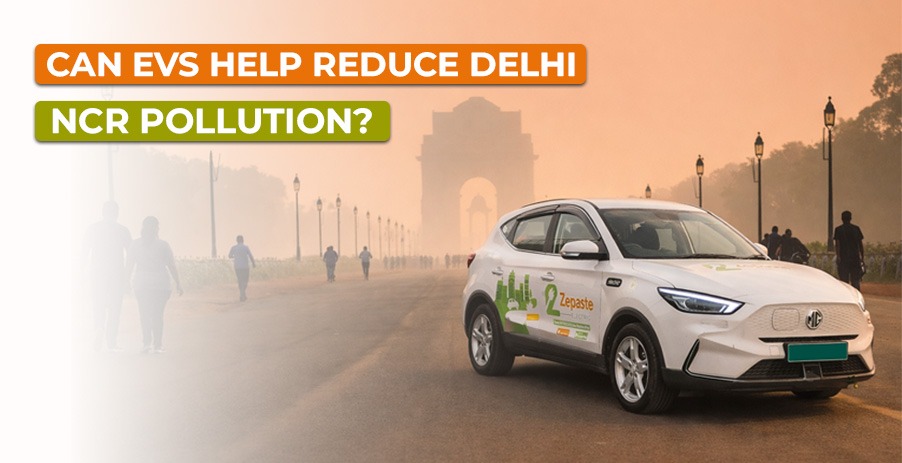
Every year, as winter settles in the National Capital Region (NCR), so does the familiar and suffocating air pollution that envelopes this region every winter. As a result of this pollution, headlines scream of Air Quality Index (AQI) ratings of “Severe,” schools are forced to close down, and construction work stops. Despite this, the haze continues to linger. The rising pollution levels in the Delhi NCR are far from being a seasonal problem and instead represent a long-term public health crisis which necessitates a transformational response to address it effectively.
Although there are multiple sources of this pollution including stubble burning by farmers in neighbouring states, industrial activities, and construction debris, the most dominant pollution source is vehicular emissions since they are emitted constantly throughout the year. On a daily basis, all the vehicles in Delhi, Gurgaon, Noida and Ghaziabad produce large quantities of PM 2.5, PM 10, nitrogen oxides and Carbon Monoxide.
In an effort to find solutions to this situation, one technology that may provide a solution to the air quality issue is Electric Vehicles (EVs). However, will use of battery-powered transportation truly have an impact on reducing pollution and therefore cleaning the air in the NCR?
The Exhaust Problem
Understanding the solution requires recognizing the magnitude of the problem. The National Capital Region (NCR), as one of the largest economic engines in India, depends greatly on transportation. Each day, millions of cars, two-wheelers, three-wheelers, and heavy commercial vehicles travel through this area.
All internal combustion (ICE) vehicles now use either petrol or diesel, with CNG being a cleaner fuel alternative (compared to diesel), however it's not a zero-emissions product. The emissions produced when an ICE vehicle accelerates (see below) are expelled through the tailpipe into the atmosphere near the ground level creating the "street canyon effect". Affected areas with tall buildings along both sides of the street trap these pollutants in between creating a very unhealthy environment for pedestrians, cyclists and people living in that vicinity to inhale the most concentrated, toxic air at the source.
The need for eco-friendly transportation to and from Delhi NCR will only continue to grow as we move away from combustion engines to cleaner propulsion systems using renewable unit energy sources.
The EV Advantage: Zero Tailpipe Emissions
The main reason Electric Vehicles (EVs) are considered an anti-pollution tool is really about a simple mathematical fact. They produce no tailpipe emissions. Therefore, if an individual were to drive an EV in Delhi, they would not emit any PM2.5, nitrogen oxides or volatile organic compounds.
When an EV swap replaces a diesel SUV with an EV in traffic, there is an immediate and localized improvement to the air quality in that section of roadway. If we assume many tens of thousands of vehicles are operating daily in this way, the cumulative impact on urban air quality would be very significant.
One of the most often cited arguments against EVs is the "long tailpipe" argument - the idea that EVs are only as clean as the electricity used to charge them. However, it is true that in a scenario where India uses primarily coal to generate electricity for its EV charging infrastructure, pollution resulting from a coal-driven EV is transferred from a city centre to the energy production facilities. On the whole, however, when factoring in the coal-fired generated electric power, large scale coal-fired power generation facilities are substantially more efficient and use enhanced emissions reduction technologies than an entire fleet of old gasoline and diesel engines. The ongoing transition to a greener electricity generation mix through solar and wind resources, in conjunction with the growing number of EVs, will reduce the overall carbon footprint associated with EV operation, even when coal is used to charge them.
The Strategic Importance of Commercial Fleets: The Gurgaon Example
While personal EV adoption is rising, the real battleground for immediate pollution reduction lies in the commercial sector: taxis, delivery fleets, and three-wheelers. These vehicles are on the road for 12-15 hours a day, covering hundreds of kilometers—far more than the average personal car that sits parked for 90% of the time.
Consider the daily commute between Delhi and its corporate satellite, Gurgaon. The NH-48 connects these two hubs and is one of the busiest corridors in the country, choked daily with cab aggregators and corporate shuttles.
This is why the push for an electric car for taxi in Gurgaon is more than just a trend; it is an environmental necessity. A single diesel taxi converted to an electric one in Gurgaon has a disproportionately positive impact on the environment compared to converting a personal use vehicle.
Gurgaon, with its high concentration of corporate offices and heavy reliance on app-based taxi services, is the perfect test bed. If the thousands of cabs shuttling employees between Cyber Hub, Golf Course Road, and Delhi were electrified, the reduction in daily emissions along this critical corridor would be substantial. The Haryana government and various corporate entities are already incentivizing this shift, recognizing that greening the fleet is essential for long-term sustainability.
Challenges on the Road to Electrification
If EVs are the solution, why is the NCR still choking? The transition is happening, but it faces significant headwinds.
1. Charging Infrastructure: While improving, the density of public charging stations in Delhi NCR, and particularly the reliability of chargers in areas like Gurgaon and Noida, needs massive scaling up to support commercial fleets that cannot afford long downtimes.
2. Initial Cost: EVs still carry a higher upfront price tag than their ICE counterparts, though total cost of ownership (TCO) is often lower due to fuel and maintenance savings.
3. Range Anxiety: For taxi operators, the fear of running out of charge mid-trip remains a psychological barrier, even though current generation EVs offer sufficient range for typical daily city operations.
Conclusion
Can EVs help reduce Delhi NCR pollution? The answer is an unequivocal yes. They are practically the only viable solution to address vehicular tailpipe emissions in the short to medium term.
However, EVs are not a magic bullet that will solve the entire air quality crisis overnight. They must be part of a broader strategy that includes tackling industrial emissions, managing construction dust, stopping crop residue burning, and vastly improving public mass transit systems like the Metro and electric bus fleets.
The shift towards eco-friendly transportation in Delhi NCR is inevitable. The faster we accelerate this transition—particularly by targeting high-mileage commercial segments like the electric car for taxi in Gurgaon sector—the sooner the residents of the capital region can hope to breathe freely again. The technology is here; the imperative now is adoption and infrastructure.
Are you looking for smarter, cleaner transportation solutions in the NCR region? Whether you are looking to modernize your fleet or find efficient commuting options, navigate the future of transport with ease.
Explore innovative mobility solutions today at Zepaste.